
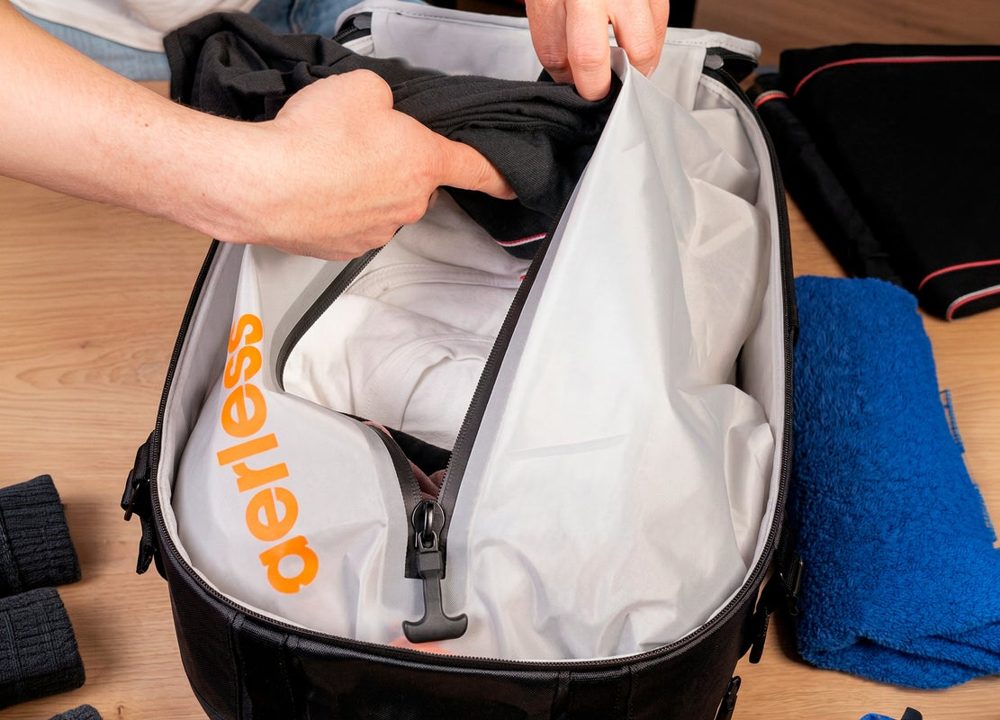
Vacuum bags vs compression bags for packing comes down to one trade: vacuum bags save more space, compression bags are easier to live with on a trip. Both squeeze the air out of your clothes so more fits in the case. They just go about it differently, and the right pick depends on how you travel.
If you want the short answer: for the most space, especially with bulky winter clothes, vacuum bags win. For a simpler, pump-free option you can open and reseal all trip, compression bags are the practical choice. Below is how each works, what the space numbers really look like, and the one design that gives you both.
How each one works

A vacuum bag removes air with a pump, so it shrinks tight around whatever’s inside. You load it, seal the zip, and run a pump, either a manual hand pump or a small electric one, until the bag collapses to a fraction of its size. No air, no bulk.
A compression bag skips the pump. You fill it, close the seal, then roll it up or press down to force air out through one-way valves. It’s quicker and there’s no device to carry, but it only gets as flat as your own pressure makes it.
That single difference, pump or no pump, drives everything else: how small things get, how much they wrinkle, and how easy the bag is to reopen.
Which saves more space

Vacuum bags save more, and it isn’t close for bulky items. Pulling a real vacuum on a bag of sweaters or a jacket collapses the trapped air that makes clothes puffy, which a roll-and-press bag can’t fully reach.
The exact numbers are seller estimates, so take them as rough. Makers of vacuum bags commonly claim up to 75 to 80 percent volume reduction on bulky, air-heavy items, while compression bags are usually pitched around 40 to 60 percent. The ranges overlap on thin clothes, where both do fine, and separate on the bulky stuff, where the pump pulls ahead.
The honest rule: the puffier the item, the bigger the vacuum-bag advantage. For t-shirts and jeans, a compression bag is often plenty. For a parka, vacuum wins.
Wrinkles, convenience and reopening
Compression bags wrinkle clothes a little less, and they’re easier to reopen mid-trip. Because they don’t pull out as much air, garments aren’t crushed as hard, so creasing is gentler. And with no pump to find, you can reseal them anywhere.
Vacuum bags trade some of that convenience for space. Reopening one on the road means you’ll want to recompress it, which needs the pump again. If you live out of your bag and repack daily, that’s friction. If you pack once and unpack at your destination, it’s a non-issue.
So the question under the question is really: do you rummage, or do you pack and go? Rummagers lean compression. Pack-and-go travelers lean vacuum.
The option that does both

The frustration with classic vacuum bags, needing a household vacuum cleaner, disappears when the bag brings its own pump. A travel vacuum bag with a small rechargeable electric pump gives you vacuum-level compression in a hotel room, with none of the hunting for an outlet-powered vacuum.
That’s the niche the Aerless vacuum compression bags fill: vacuum-bag space savings with a built-in rechargeable pump, so you get the hard compression without the household-vacuum hassle. Our full review digs into how far it actually shrinks a load and whether the pump holds up. For the wider field, see the best travel vacuum bags, and if you’re weighing a softer option, Aerless vs packing cubes covers the organize-don’t-compress route.
So which should you pack?
For maximum space, especially with sweaters, coats and bedding, choose vacuum bags, ideally ones with their own travel pump. For a simple, pump-free bag you can open and reseal all trip with slightly fewer wrinkles, choose compression bags.
Plenty of travelers end up carrying both: vacuum bags for the bulky layers, a compression bag for the clothes they’ll dig through daily. If you’re unsure a brand is trustworthy before you buy, our guide on whether Aerless is legit walks through the company and its guarantee, and there’s more in the travel hub.