

Clinic-fitted hearing aids can cost more than a used car, which is exactly why a $99 pair like HearWell gets a second look. The HearWell hearing aids are an over-the-counter, self-fitting pair built for people with mild to moderate hearing loss who want to hear conversations clearly again without a prescription or a five-figure bill.
HearWell is made by Nebroo and sold direct online. It’s a rechargeable, near-invisible in-canal device, sold as a pair with a charging case, at a one-time price with no subscription.
For this HearWell hearing aids review we didn’t wear a set ourselves. We read Nebroo’s spec claims, weighed real owner ratings on Trustpilot, and compared HearWell against the OTC hearing aids people already know, like Audien and MDHearing. Here’s the honest picture.
What the HearWell hearing aid is
The HearWell hearing aid is a completely-in-canal (CIC) over-the-counter device, the kind that sits inside your ear and is very hard to see from across a table. You buy it as a pair, both ears, which is worth stressing because plenty of cut-price aids quietly sell you a single unit.
It’s rechargeable. The two aids drop into a portable charging case, so there are no tiny disposable batteries to fumble with, and the case tops them up between wears.
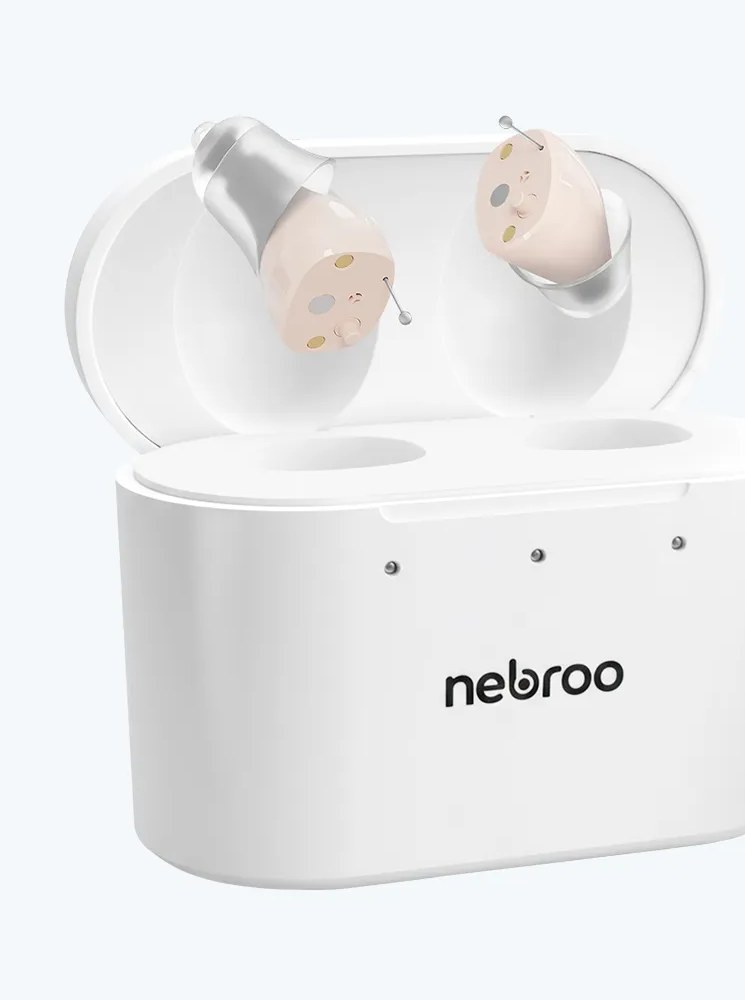
There’s no app and no Bluetooth here. You adjust it with buttons on the device itself. For some buyers that’s a downside, but for plenty of older users the no-phone, no-pairing simplicity is the entire appeal.
Key specs

The headline number is 16-channel digital sound processing, which splits incoming sound into bands so the aid can lift the frequencies you struggle with. Nebroo pairs that with adaptive noise reduction, three listening modes, and six volume levels you step through on the device.
Fit comes from a set of multiple ear-tip sizes in the box, so you can match the dome to your own canal for a secure, comfortable seal. That seal matters more than people expect: a loose tip is the usual cause of whistling feedback in any in-canal aid.
On battery, Nebroo lists 30-plus hours per charge, while independent reviews put real-world use closer to 16 to 20 hours. Either way, wear them through the day and drop them in the case overnight and you’ll never think about charge level. Nebroo also backs the aids with a one-year warranty against technical faults.
What the evidence shows
Here’s the honest framing. HearWell is an amplification-first device, so it makes the sound around you louder and clearer rather than surgically isolating one voice in a crowd. That’s true of essentially every OTC aid at this price, and it’s why the technology suits mild to moderate loss and quieter rooms best.

The useful insider detail the sales page won’t lead with: give your ears about a week to adjust, and start at a lower volume level. New hearing-aid users who crank the volume on day one often decide the device is “too harsh,” when the real fix is a gradual ramp-up as your brain re-learns sounds it has been missing.
For a busy restaurant, temper expectations. Separating speech from clatter is the job that thousand-dollar aids charge for. At $99, HearWell earns its keep on one-on-one conversation, the TV, phone calls, and the front of a quiet room.
What owners say
Across roughly 500-plus Trustpilot reviews, HearWell averages about 3.7 out of 5, which is a genuinely mixed-to-positive score for a budget OTC brand. The recurring praise is clear sound for the money and a discreet fit; the recurring gripe is the usual budget-aid limit in noisy places.
How it compares
The most direct rival is Audien, whose entry-level Atom ONE lands around $98, making it the natural price comparison, though the step-up Atom 2 costs more. Our Audien Atom 2 review covers that side, our best OTC hearing aids under $150 roundup puts the whole budget tier head to head, and our Audien Atom 2 vs Eargo comparison shows what a big jump in price actually buys.
Step up in price and you meet MDHearing (around $297) and, higher still, app-driven and audiology-supported brands like Jabra Enhance (near $995), which add professional tuning and more noise-handling muscle. If you want that level of support and can spend it, they deliver more. HearWell’s pitch is different: near-invisible, rechargeable, no-subscription hearing help for about a tenth of that top price.
Pros and cons
What we liked
- Around $99 for a full pair with a charging case, a fraction of clinic-fitted aid prices
- Near-invisible in-canal fit with several ear-tip sizes for a comfortable, discreet seal
- Rechargeable with a case, so there are no tiny disposable batteries to swap
- Simple on-device controls with 16-channel processing, 3 modes, and 6 volume levels, no app or pairing needed
What we didn't
- Only available online
Who it’s for
HearWell fits the reader with mild to moderate hearing loss who wants voices, the TV, and phone calls to come back into focus without a clinic visit or a huge bill. If you value a discreet fit and dead-simple controls over app-based fine-tuning, the HearWell is squarely aimed at you, and its one-year warranty covers you against technical faults.

If your loss is severe, or you spend most of your listening time in loud, crowded rooms, plan to spend more for a professionally tuned aid. That’s a different tier of device, and it’s honest to say so. Cross-shopping the budget field is smart too: our Oricle hearing aid review covers another rechargeable self-fit pair at a similar price.
Verdict
For $99 a pair, HearWell delivers the thing most budget buyers actually want: clearer everyday conversation from a rechargeable aid nobody can see, with no subscription and no app to wrestle. Start low, give it a week, and enjoy hearing the room again.
Check today's HearWell price